Skip to content
Badge
Voldt® Portable Charger Type K with Danish Type K plug and Type 2 connector Electric car charging at home from a household socket with the Voldt® Portable Charger Voldt® app on a smartphone showing live charging data Hand holding the in-cable control box of the Voldt® Portable Charger Voldt® Portable Charger storage case and packaging Driver next to an electric car charging with the Voldt® Portable Charger Type 2 connector of the Voldt® Portable Charger
IP67 Protection class
Delayed charging available

Voldt® Portable charger Type K 230V | 8A - 13A | 2.8kW + APP

0 Total reviews
0
5m
10m
15m
20m
€184,00
Voldt® Portable charger Type K 230V | 8A - 13A | 2.8kW + APP
Free shipping
3 year warranty3 year warranty
100 days hassle free return100 days hassle free return
Free shippingFree shipping
Electric car charging at home from a household socket with the Voldt® Portable Charger

Control your charging experience via APP

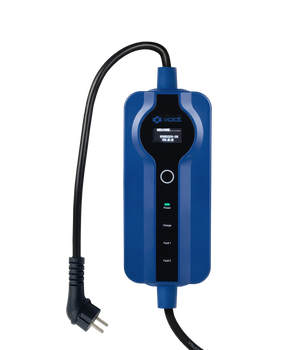
Take control of your portable charging experience through the Voldt® smartphone APP.

Hand holding the in-cable control box of the Voldt® Portable Charger

Carefully tested

Every Voldt® product is carefully tested in real world situations

Voldt® Portable Charger storage case and packaging

Made in Europe

Our products are designed, produced and manufactured in Europe.

Voldt® Portable charger Type K 230V | 8A - 13A | 2.8kW + APP

Charge your EV from any standard Danish wall socket, with full control from your phone. This is a native Type K charger, so the plug goes straight into the socket with no travel adapter in between. That matters more than convenience: a Schuko plug forced into a Danish socket earths through side clips that a Type K socket has nowhere to meet, and Mode 2 charging depends on a working protective earth for its residual current protection to function. One plug, one connection, earth path intact.

The charger delivers up to 2.8 kW at 13 A, single-phase, which is the full rating of a Danish Type K socket. Most portable chargers cap output at 10 A. Voldt® runs the complete 13 A, up to 30% faster than a 10 A charger, and adjusts automatically between 8 A and 13 A based on the load already on the circuit. You can set the current manually via the Voldt® app or the in-cable control box (ICCB), which is worth having in a summer house or an older property where the installation was never designed for a continuous 13 A draw. Built-in temperature sensors and overvoltage protection monitor conditions throughout every session, scaling back output or pausing the charge if safe thresholds are exceeded.

Because the socket is already there, nothing needs installing. No wallbox, no electrician, no application to the housing association and no waiting for a decision at the next general meeting. Plug in and the built-in Mode 2 controller handles safe, stable charging on any circuit. The integrated LCD screen displays live session data including charge time, speed and charger temperature. Compact and easy to carry, the charger goes in the boot for the drive to the summer house and stores in a cupboard the rest of the time. For a permanent setup in a garage or utility room, the Voldt® Boxx (sold separately) provides wall-mounted storage in recycled plastic with a metal front panel and magnetic closure, keeping the charger and cable protected from dust and knocks. Always plug the charger directly into a wall socket, never into an extension lead or multi-way adaptor.

Ten hours at 2.8 kW delivers around 28 kWh, roughly 160 km at typical consumption. Danish drivers average close to 40 km a day, so a single overnight charge covers three to four days of normal use.

The Voldt® App

On an hourly settled electricity tariff, when you charge decides what you pay. The Voldt® app schedules sessions into the cheap hours, which on the Danish grid tend to fall overnight and on windy days when wind generation is high and prices drop, occasionally below zero. Set the window once and every session follows it. The app connects via WiFi or Bluetooth for real-time voltage, current and power draw, with remote start and stop. A full session history logs energy consumed per charge, exportable for expense tracking or to see what your driving actually costs per kilometre. Multiple users can be linked to a single charger, each with individual usage logs. Firmware updates arrive automatically through the app.

Voldt® app on a smartphone showing live charging data
Driver next to an electric car charging with the Voldt® Portable Charger

Specifications

Charging capacity 2.8kW
Phases 1 Phase
Amperage 13A
Mode Mode 2
Protection class IP67
Certificates CE, UKCA & TÜV
Insertion/extraction >10.000x
Working temperature -30°C ~ +50°C
Cable weight 300 g/m
Extra feature Delayed charging
Type Charging cable

European charging cables

The portable charger is IP67 rated and certified to CE, UKCA and TÜV standards. Protection runs on several layers: automatic shutdown on overheating, over and undervoltage protection, and earth leakage detection. The operating range is -30 °C to +50 °C, which covers a Danish winter with margin. Every unit carries a 3-year warranty, one year beyond the statutory two.

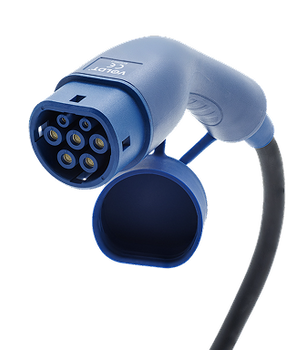
Our plugs are moulded in one piece rather than glued or screwed together, which makes them stronger, more wear-resistant and better sealed than assembled alternatives. The contact pins are 100% copper with a silver-plated finish to resist corrosion across more than 10,000 plug cycles. In coastal air, where salt attacks exposed contacts faster than anything inland, that finish is the difference between a plug that lasts and one that pits. The cable is rated at 300 g/m and stays flexible in the cold rather than stiffening into coils that won't sit flat.

Delayed charging without your phone

Scheduling through the app is the easier route, but the charger also delays a session on its own if your phone isn't to hand. Power on the charger, connect the vehicle, then hold the adjustment button for three seconds to enter delayed charging mode. Each further three-second press adds an hour, up to a maximum of ten. The countdown begins once you stop pressing, and charging starts when it reaches zero.

Type 2 connector of the Voldt® Portable Charger

Not sure which cable you need?

Voldt® Portable Charger Type K with Danish Type K plug and Type 2 connector
Our plugs are moulded from one piece, with no glue or screws. One-piece construction, IP67-rated, tested beyond 10,000 connection cycles.
Join 100,000+ EV drivers across Europe, from the Netherlands to Norway, who trust Voldt® to keep them powered every day, everywhere.

Built for a long service life. IP67 protection.

Made in EU quality badge for European manufactured EV charging cables
3 year warranty
ISO 9001 certified quality management badge
100 days hassle free return
White shield with checkmark icon for the 2-year warranty on Voldt EV charging cables
Free shipping

Voldt®: Powering the Next Century of Driving

With more than 100 years of combined experience in the automotive industry, Voldt® embodies a legacy built on engineering excellence, craftsmanship, and innovation. Our deep heritage gives us a unique understanding of mobility and the evolving needs of electric vehicle drivers. As the world shifts toward cleaner transportation, we apply a century of expertise to create charging solutions that deliver true reliability, long-lasting performance, and a quality user experience.

Vintage photo collage of two classic delivery vans from the history of Voldt EV charging cables

Voldt® will integrate with your electric vehicle seamlessly.

In some sockets you can, but the earth connection is the problem. A Schuko plug earths through side clips, and an older Danish Type K socket has nothing to meet them with. Newer combination sockets accept both plug types, but you cannot tell what a socket does by looking at it, and Mode 2 charging needs a working protective earth for the residual current protection to function. A native Type K plug removes the question entirely. It also removes one connection that can work loose or heat up while the charger draws 13 A for hours at a time.

Worth checking before you order: this charger fits Type K sockets and the combination sockets found in most newer Danish installations. A small number of installations built or rewired since 2008 use pure Schuko sockets, which have no hole for the Type K earth pin. If the socket you plan to charge from is Schuko, order the Schuko version of the same charger instead. Same electronics, same app, same protection, correct plug for the socket you actually have.

Yes. The current can be set down to 8 A in the Voldt® app or on the in-cable control box, and the charger already adjusts automatically to the load on the circuit. An EV draws current for hours on end, which is a different demand from a kettle running for three minutes, so 8 A is the safe setting in an older summer house on old circuits. If you are unsure what condition the circuits are in, have an electrician look at the fuse board first.

At 8 A the charger delivers around 1.8 kW, which works out to roughly 18 kWh over ten hours, or about 100 km of range. Slower than the full 13 A, and still enough to cover a weekend at the summer house and the drive home. Keep the charging circuit to itself while a session runs, so no water heater, oven or heat pump on the same group, and check that the group is not already shared with half the house. The built-in temperature sensors monitor the plug and the control box throughout, and will scale output back or pause the session if anything runs warmer than it should.

For most people, yes. Ten hours at 2.8 kW gives around 28 kWh, roughly 160 km at typical consumption. Danish drivers average just under 40 km a day, so a single night on the socket covers three to four days of driving. With a plug-in hybrid, 2.8 kW fills the battery several times over in one night. If you drive long distances daily, a wallbox is the right choice, and this charger is still the one that lives in your boot.

Your car is not the limiting factor here. Every EV on sale has an onboard charger rated well above 2.8 kW, so the socket sets the pace, not the vehicle, and the charger delivers the same output regardless of what you drive. Expect somewhat less range per session in hard frost, since part of the energy goes to warming and conditioning the battery rather than filling it. Scheduling the session in the app so it finishes close to your departure time helps here: the car comes off the socket with a warm battery, which improves both range and comfort on the first few kilometres.

Set a schedule in the Voldt® app. If you are on an hourly settled electricity price, the rate changes through the day, and on the Danish grid the low hours usually fall at night and on windy days when wind generation is high. Prices occasionally drop below zero. Plug in when you get home, tell the app when to start, and the session runs while the price is low instead of during the expensive evening hours. Set the window once and every session after that follows it.

There is a second saving that is easy to overlook. Danish grid companies apply time-differentiated network tariffs, with the highest rate in the late afternoon and early evening when consumption peaks. Moving your charging to the night reduces both the electricity price and the network tariff on the same kWh. The app's session history logs consumption per charge and can be exported, so you can check what each session actually cost and adjust the window if your tariff changes.

A portable EV charger is a flexible charging device that allows you to charge your electric vehicle anywhere with access to power. It connects directly to a household socket or industrial outlet, eliminating the need for a fixed wallbox. Compact and easy to transport, it delivers the same safety and reliability as a stationary unit while giving you the freedom to charge at home, at work, or while travelling. Voldt®’s range of portable EV chargers is compatible with both Type 1 and Type 2 connectors and includes adjustable amperage control for optimal charging speed.

A portable EV charger works by safely converting AC power from the grid into a controlled current for your vehicle’s battery. The internal control box manages power flow, monitors temperature, and prevents overcurrent or short circuits. Simply plug one end into a power source and the other into your EV’s charging port. With amperage settings from 8A to 32A and output options from 2.8 kW to 22 kW, Voldt® chargers ensure secure, efficient charging on single-phase or three-phase connections.

If you place your order before 15:00 on a working day, it will be shipped the same day. Voldt® offers free same-day shipping as part of our commitment to fast and reliable service. Delivery usually takes between 1 and 2 business days, depending on your location and the courier’s schedule. All orders are dispatched directly from our European warehouse and include full tracking, so you can follow your package from dispatch to delivery with complete peace of mind.

Once you have placed your order and made your payment, you will automatically receive an email with information about the tracking number of your parcel.

Man lifting a blue Voldt EV charging cable out of the front trunk of a white Tesla

Contact us for more information

Woman standing next to a green electric SUV charging from a wallbox with a Voldt EV charging cable

For questions or general inquiries, please leave your contact information below and we will get back to you as soon as possible.

Thank you for submitting your form!

We appreciate your interest and will review your information as soon as possible.

Our team is dedicated to providing excellent customer service, and we will do our best to respond promptly.