


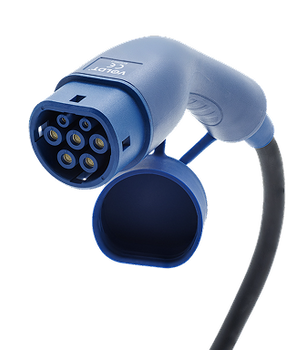
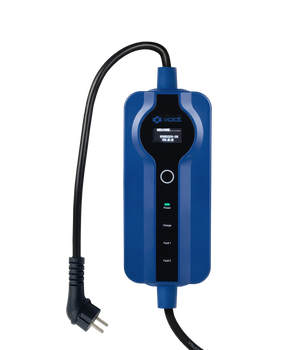
What is mode 2 charging?
Mode 2 charging is a method where an electric vehicle (EV) is charged using a standard household socket or a reinforced industrial socket, with a special charging cable that provides limited communication and safety features. It is mainly intended as a solution for situations where a charging station is not available.
Features of Mode 2 Charging:
- Charging via a standard or industrial socket
- Limited safety with standard sockets
- Charging speed depends on the connection
- Easy setup, but not always ideal for daily use
Advantages of Mode 2 Charging:
✔️ Simple and widely available, as most homes have power sockets.
✔️ No charging station installation required, making it ideal for occasional charging.
✔️ With a three-phase power connection (CEE 400V), it can charge as fast as Mode 3.
✔️ Useful as a backup option or in locations without a charging station.
Disadvantages of Mode 2 Charging:
❌ Very slow with a standard household socket.
❌ Standard sockets can overheat, making them less safe for regular use.
❌ No smart charging features, such as load balancing or scheduled charging, when using standard sockets.
Comparison with Other Charging Modes:
- Mode 1: No communication between the power source and the vehicle (outdated and not recommended).
- Mode 3: Charging via a charging station or wallbox, with advanced communication and up to 22 kW power.
- Mode 4: DC fast charging via a fast-charging station (e.g., CCS or CHAdeMO), often up to 350 kW.
Mode 2 charging is a practical solution for charging an EV, particularly when a charging station is unavailable. With a standard socket, it is slow and less safe, but with a three-phase power connection (CEE 400V), Mode 2 can charge just as fast as Mode 3. 🚗⚡
