



Published 27/09/2026 · Updated 27/09/2026 · By Voldt® product team
Home charging of a company EV is reimbursed correctly when a certified meter records each session and sends it to the fleet platform. Companies register about 60% of new cars in the EU, so the question now reaches most fleets (European Commission, December 2025). A portable charger with a MID-compliant meter and OCPP does both from an ordinary socket, with no wallbox to install.

Voldt® · session 0142
Plugged in
22:10
Unplugged
05:52
Duration
7 h 42 min
Driver
ID 0417
Total
energy
24,6kWh
Meter
00482,1 → 00506,7 kWh
✓ Sent via OCPP 1.6 JSON
meter
Key points
Home-charging claim
Example
kWh, company car only
24,6 kWh
from the charger
Date and time
27/09, 22:10 to 05:52
from the charger
Driver or car
ID 0417
from the charger
Price per kWh
€ ___ per kWh
agreed by you
01 · Fleets
Why are more employers reimbursing home charging?
Because company fleets are switching to electric cars, and an EV that charges at the driver's home runs on the driver's electricity.
Corporate buyers account for about 60% of new car registrations in the EU and up to 90% of new vans (European Commission, December 2025). The Commission has proposed a Clean Corporate Vehicles Regulation that would oblige member states to reach set shares of zero- and low-emission registrations by large companies from 2030, still under negotiation in the European Parliament (June 2026).
National tax rules move faster. The Netherlands is one worked example: from 1 January 2027 an employer pays a levy of 12% of the catalogue value every year on a petrol, diesel or hybrid company car that the employee may also use privately, commuting included (Belastingplan 2026). Fully electric cars are exempt, so the levy alone adds €6 000 a year to a hybrid with a catalogue value of €50 000.
Fig. 1
What the Dutch levy adds per year

€40 000
catalogue value
€50 000
catalogue value
€60 000
catalogue value
Fully electric
exempt
One coin = €600
12% of the catalogue value including VAT and BPM, per year from 1 January 2027 (Belastingplan 2026; KVK, September 2026).
Every switch creates the same follow-up task. The electricity appears on the driver's private bill, and the employer has to repay the car's share without paying for the rest of the household. Metering the car itself is the simplest way to split that bill.
Voldt® tip
Agree the price per kWh in writing when you hand over the car: the driver's own tariff, updated yearly, or a rate set by national rules. With the kWh from the meter, the price is the only number left to agree.
02 · Measuring
Why can't the household meter or the car's app settle the bill?
The household meter mixes the car with everything else in the home, and the car's app counts only what reached the battery, after charging losses.
A home meter records the whole household in one figure: cooking, heating, laundry and the car. Splitting that total by estimate invites disputes, and tax offices increasingly want the car's own reading. Germany is an example: since 1 January 2026 an employer can repay home charging of a company car tax-free only when a separate meter shows the kWh (BMF letter, 11 November 2025).
The car's app looks like an easy alternative, but it measures energy after the losses in the car. In an ADAC test of five current EVs, 12,7 to 24,2% of the electricity drawn from a 2,3 kW household socket never reached the battery; at an 11 kW wallbox the loss fell to 5,1 to 7,0% (ADAC, August 2026). Reimbursing from the app underpays the driver by that share.
Fig. 2
Where 100 metered kWh end up
Household socket
2,3 kW
Wallbox
11 kW
reaches the battery
lost in some cars
lost in every car
ADAC measurement of five EVs charged from 10 to 90%, published 6 August 2026.
A meter inside the charger measures before the car, so the losses in the car are part of the metered kWh, as they are on the electricity bill. MID-compliant means the meter meets the EU Measuring Instruments Directive (2014/32/EU), which covers electricity meters used for billing.
03 · Data
How does a charging session get from the drive to the payslip?
The charger sends each session over OCPP to a backend, and the backend turns the sessions into a statement for payroll.
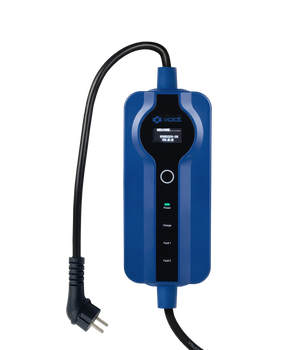
OCPP, the Open Charge Point Protocol, is the open language between a charge point and the software that manages it. The Voldt® Portable OCPP Charger speaks OCPP 1.6 JSON and has a communication module with SIM, Wi-Fi and Bluetooth. From the backend's side it behaves like a fixed charge point, so it needs no Voldt® platform of its own.
Each session arrives with its start and end time, the meter readings and the kWh. Platforms such as E-Flux, Last Mile Solutions and Shell Recharge collect these sessions, apply the agreed price and produce a monthly statement for the employer or lease company. Nobody types in a meter reading or sends a photo of the car's screen.
Fig. 3
The path of one charging session
Charger
MID meter reads the kWh
OCPP
Sent over SIM or Wi-Fi
Backend
E-Flux, Shell Recharge and others
Payroll
Statement or payslip
Sent with every session: ● kWh ● start and end time ● meter readings ● driver ID
Voldt® Portable OCPP Charger specification.
Check one detail before you order: OCPP 1.6 and 2.0.1 are separate versions that cannot talk to each other (Open Charge Alliance), so your platform must accept 1.6 JSON connections. Version 2.0.1 became the international standard IEC 63584 in October 2024.
Voldt® tip
Enter the backend address and the charge point ID in the Voldt® app before the charger goes to the driver, then run a five-minute test session. If it appears in the backend with its kWh, the chain works and the driver never needs the settings.
04 · Power
How fast does it charge from each socket?
Up to 3,7 kW from a household socket, and up to 11 or 22 kW from a three-phase CEE socket, depending on the car.
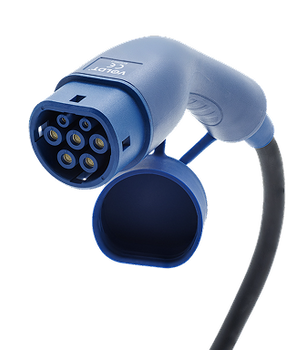
The charger takes its power through interchangeable adapters: a household socket (Schuko), CEE industrial sockets of 16 A and 32 A, and a Type 2 adapter for public AC posts. The Basic set includes the Type 2 and Schuko adapters, and the Pro set adds CEE. The socket sets the ceiling, and the car's on-board charger decides how much of it is used.
Fig. 4
Hours to draw 25 kWh, starting at 22:00
6,8 h
Household socket
Schuko, 16 A · 3,7 kW
2,3 h
CEE 32 A, three-phase
car takes 11 kW
1,1 h
CEE 32 A, three-phase
car takes 22 kW
Rated power at 230 V per phase. Most cars take 11 kW on AC.
At 3,7 kW a household socket delivers about 30 kWh in an eight-hour night, around 160 km for a car that uses 18 kWh per 100 km. Three-phase sockets charge faster, and in the ADAC figures above the loss on the way to the battery was lower at 11 kW.
With the Type 2 adapter the charger also works at public AC posts. Those sessions are billed by the post's operator through a charge card, so reimburse them from the operator's invoice and leave them out of the charger's statement.
Voldt® tip
On a household socket, run the first sessions at a lower current in the app and check after an hour that plug and socket are no more than warm. Older wiring is the weak point; an electrician can confirm the circuit carries 16 A all night.
05 · Choice
When is a portable OCPP charger a better choice than a wallbox?
When a wallbox cannot or should not be installed, or when the car, the driver or the address may change during the lease.
A fixed wallbox with a MID meter and OCPP does the same metering job and charges faster at home when the house has three phases. It also needs an installation, a place on the wall and, in rented homes, the landlord's consent. When the employee leaves, someone has to remove it or buy it out.
The portable charger moves with the car. It suits drivers who rent, drivers who may change job or address within the lease term, and pool cars that different people take home. One device follows the car from one driver to the next, and the metering history stays in the backend.
Fig. 5
Which option fits which driver
Rents the home
A wallbox needs the landlord's consent.
Best fit
Portable charger
May leave within the lease
A wallbox then has to be removed or bought out.
Best fit
Portable charger
Takes a pool car home
Different drivers, one car, several addresses.
Best fit
Portable charger
Owns the home, three phases, high mileage
Charges most nights at high power.
Best fit
Fixed wallbox
Voldt® product team assessment.
For a homeowner with three-phase supply and high mileage, a fixed wallbox remains the better option, and a mixed fleet can use both.
Our verdict
Reimburse home charging from metered sessions rather than estimates, because tax rules increasingly ask for the kWh per car. The portable OCPP charger gives that record from a socket where a wallbox is impractical, and a fixed wallbox is faster for high-mileage homeowners with three phases.
01
Connect the charger to your platform first
02
Agree the kWh price in writing
03
Charge from a checked, earthed socket
Buy it if
your drivers charge at home without a wallbox, rent or share cars, and you want every session metered
Skip it if
your drivers already have fixed OCPP wallboxes with MID meters, or your platform only accepts OCPP 2.0.1
Voldt® Portable OCPP Charger

Basic set
Charger with MID-compliant meter
Type 2 adapter for public AC posts
Schuko adapter for household sockets
7,5 m cable

Pro set
Everything in the Basic set
CEE adapters for 16 A and 32 A sockets
Up to 22 kW on three phases where the car allows
CE and TÜV certified · MID-compliant meter · 3-year warranty · 100-day returns
Safe use and warranty
- Use only the charger's own Voldt® adapters, plugged straight into a sound, earthed socket, never an extension lead.
- Have an electrician check that a household circuit carries 16 A for hours before nightly use.
- Where your car's manual differs from this guide, follow the manual.
Voldt® cables and portable chargers are CE marked and TÜV certified, with a 3-year warranty; terms and exclusions are on the warranty and complaints page.
CE · TÜV · IP67 · 3-year warranty · 100-day returns
Frequently asked questions about reimbursing home charging
Can an employer reimburse home charging of a company EV tax-free?
That depends on national rules, which usually hinge on the kWh the car used. The Netherlands treats the actual electricity cost of a company car as a business expense, and Germany has required a separate meter for tax-free repayment since January 2026.
Does the charger need a wallbox or a fixed installation?
No. It plugs into a household or CEE socket, though an electrician should check the circuit before regular use.
Which platforms can receive the sessions?
Any backend that accepts OCPP 1.6 JSON, such as E-Flux, Last Mile Solutions or Shell Recharge. No Voldt® backend is needed.
Does it work with an OCPP 2.0.1 platform?
Only if the platform also accepts 1.6 JSON connections, because the two versions are not compatible. Ask your provider before you order.
Why does the car's app show fewer kWh than the charger?
The app counts the energy that reached the battery. The charger counts before the car, so charging losses are included, as they are on your electricity bill.
Can two drivers share one charger?
Yes. The Voldt® app handles user identification, so the platform can assign each session to the right driver.
Voldt® product team, product development and support
Develops Voldt® charging cables and portable chargers and answers the questions that reach Voldt® support.