


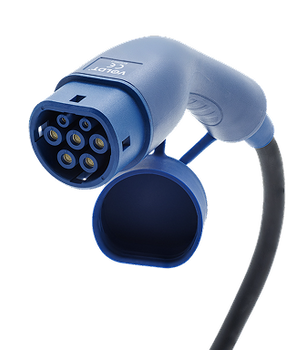

Are you wondering if extending your EV charging cable is possible? The answer to this question is a bit complicated. Technically, it is possible. The question is: should you extend your EV charging cable? Because of safety issues it is not advisable, nor is is permitted by European regulations.
Extending EV charging cables
While it may seem like a practical solution to simply extend your EV charging cable to reach your vehicle more conveniently, this approach raises serious concerns. Using standard extension cords, even heavy-duty ones, introduces the risk of overheating, voltage drops, and potential fire hazards—especially when dealing with the high current loads required for EV charging. European safety regulations explicitly prohibit the use of non-standard extension cables for this purpose. These rules are in place not just to protect your vehicle and home, but also to ensure broader public safety and prevent grid instability caused by poorly managed charging setups. EV charging stations and cables are designed as integrated systems, tested and certified to meet strict performance and safety criteria.
If you find that your existing cable doesn't reach your vehicle comfortably, the proper and safe solution is to invest in a longer, type-approved charging cable that matches your connector type (Type 1 or Type 2) and meets all relevant electrical standards. Alternatively, repositioning your charging station or installing a wallbox with a longer tethered cable may be a better long-term option. At Voldt®, we offer certified EV charging cables in various lengths—including extra-long options up to 40 meters—giving you the flexibility you need without compromising on safety or compliance. These cables are fully tested to handle the required power levels safely and meet all European regulations, making them the ideal solution for those hard-to-reach charging scenarios. Ultimately, the risks of extending an EV charging cable with unofficial solutions outweigh any short-term convenience, making regulation-compliant alternatives the only responsible choice.
So which charging solutions can you extend?
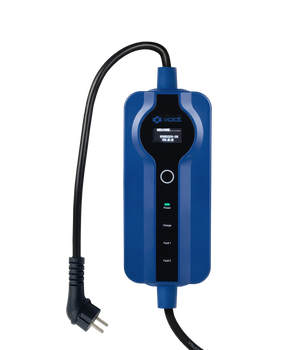
Mobile charging cables to 220-230V outlet (schuko), and mobile charging cables to power CEE outlets you can extend just fine. However, there are some important safety considerations to keep in mind:
- Make sure the extension cable is grounded.
- Make sure the extension cable is waterproof. Chances are that the plugs will be outside, so make sure the extension cable has a good IP rating.
- Make sure to use a well-veined extension cable with sufficient thickness to avoid extreme heat generation and fire hazards. A charging cable up to 16A requires a thickness of 2.5mm² and a charging cable up to 32A requires conductors of 6mm².
- Make sure you have a well-insulated cable that is sturdy and flexible to properly protect the wires in the cable.
Still, it is advisable to avoid extending an EV charging cable as much as possible and also connect a mobile charging cable directly to the wall socket. At Voldt® you can find mobile charging cables up to as much as 20 meters!
Conclusion
With the growth of the electric vehicle market, the need for an efficient and safe charging method has become increasingly important. For safety reasons, it is not recommended to extend a charging cable. With a type 1, type 3 or type 2 charging cable, it is not even possible. If you do need more length, purchase a longer charging cable of up to 40 meters. A mobile charging cable to normal socket or power current (CEE) is certainly possible. However, this is not without risk and it is recommended to use only well-insulated, properly rated cables. But even with mobile charging cables, we recommend connecting directly to the wall outlet if at all possible.